
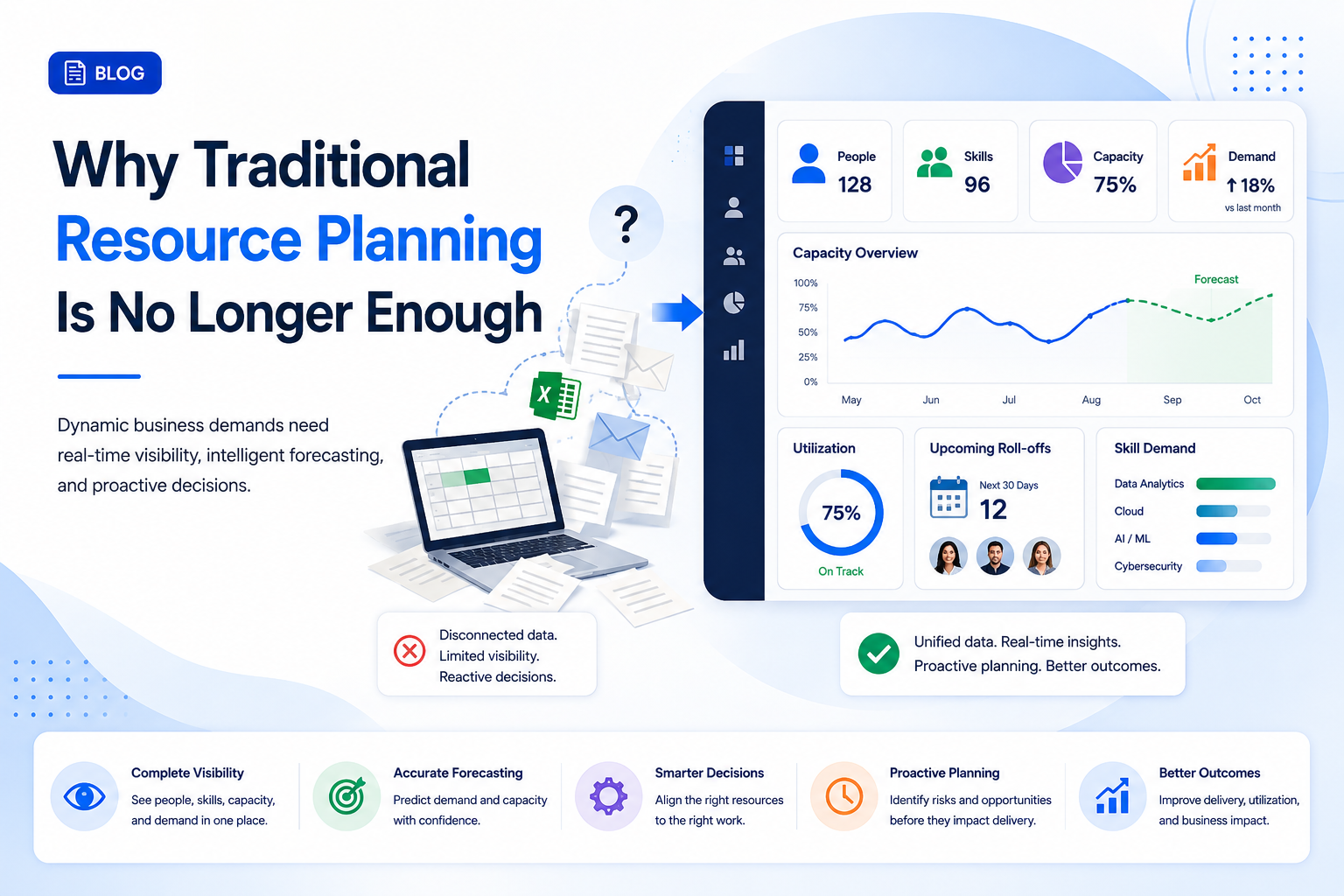
For years, resource planning was largely an allocation exercise: identify an available employee, assign that person to a project, and track utilization.
That approach worked when demand was relatively predictable and organizations managed fewer projects simultaneously. Today, delivery environments are far more dynamic. Projects change, priorities shift, employees roll off assignments, new opportunities enter the pipeline and specialized skills can suddenly become scarce.
The question is no longer simply, “Who is available today?”
Delivery leaders increasingly need to know: Who will be available next month? Which skills will become constrained? Where are we creating excess capacity? And can upcoming demand be fulfilled with the workforce we already have?
The Problem: Resource Planning Is Often Reactive.
Many organizations still manage resource decisions through spreadsheets, project-level trackers, emails, and disconnected systems.
The problem isn’t necessarily a lack of data. It’s that the information needed to make a good decision exists in different places.
Project managers know their staffing requirements. HR understands employee skills. Sales knows potential demand. Finance tracks costs. Resource managers understand availability.
When these views aren’t connected, decisions are often made after the problem becomes visible.
A resource shortage is discovered when a project needs to start. Overallocation becomes obvious when delivery slows. Bench strength gets noticed after utilization falls.
Whizible’s own guidance on smarter resource allocation highlights the limitations of spreadsheet-based planning, including lack of real-time updates and disconnected views of skills, workloads and availability.
The Solution: Move From Allocation to Capacity Visibility.
Modern resource planning needs to connect current allocation with future capacity and demand.
Instead of looking only at today’s assignments, leaders need visibility into:
- Current and future availability
- Skills and competencies
- Project roll-offs
- Bench and underutilized capacity
- Upcoming project demand
- Planned versus actual utilization
- Potential skill shortages
This creates a forward-looking resource picture.
For example, knowing that ten developers are available today is useful. Knowing that six of them will be committed within three weeks while three upcoming projects require the same skill set is far more valuable.
That is the beginning of capacity intelligence.
Platforms such as Whizible bring project, resource, utilization and business information together so delivery teams can make decisions with greater context. Whizible also describes centralized visibility into skills, workload, leave and availability as important elements of smarter allocation.
For more perspectives on project and delivery leadership, follow Dr. Vishwas Mahajan on LinkedIn.
From Planning to Intelligence
Resource planning tells you where people are allocated.
Capacity intelligence helps you understand what is likely to happen next.
That distinction becomes increasingly important as delivery organizations scale.
FAQs
-
What is resource planning?
Resource planning determines how people, skills and available capacity should be allocated across projects and business priorities.
-
Why do spreadsheets become difficult for resource planning?
They can work for smaller environments, but maintaining real-time availability, changing allocations, skills and future demand becomes increasingly difficult as complexity grows.
-
What is capacity intelligence?
Capacity intelligence combines availability, allocation, skills, utilization and future demand to support forward-looking workforce decisions.
-
Is capacity planning the same as resource allocation?
No. Allocation focuses on assigning resources, while capacity planning evaluates whether sufficient capability will be available to meet future demand.