
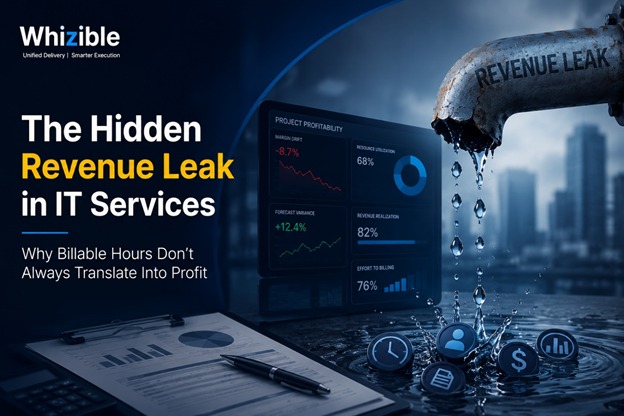
IT services organizations often assume revenue leakage happens because of pricing pressure, delayed client payments, or market competition. In reality, the biggest profitability leak usually begins much earlier — inside project delivery execution itself.
Projects continue moving forward. Teams stay occupied. Clients expect outcomes and milestones to be delivered on time.
But somewhere between planned effort, actual execution, approvals, billing cycles, and reporting, profitability quietly starts slipping away.
For many IT services firms, these losses remain invisible until margins are already impacted.
The Real Problem: Disconnected Delivery Operations
Most organizations already have access to operational data. The challenge is that the data exists across disconnected systems.
Project managers track delivery effort in one platform. Finance teams manage invoices elsewhere. Resource managers depend on spreadsheets. Leadership teams review weekly or monthly reports after execution realities have already changed.
The result is fragmented visibility and delayed decision-making.
Invisible Revenue Leakage in IT Services
Small operational inefficiencies often create major financial impact over time. Common sources of revenue leakage include:
- Unapproved effort that never gets billed
- Delayed timesheet entries affecting invoicing cycles
- Scope expansion without commercial visibility
- Bench utilization hidden inside delivery teams
- Low-margin projects consuming high-value resources
- Poor effort-to-billing alignment
- Inaccurate project forecasting and margin tracking
Individually, these issues may appear manageable. Collectively, they can significantly reduce profitability across the organization.
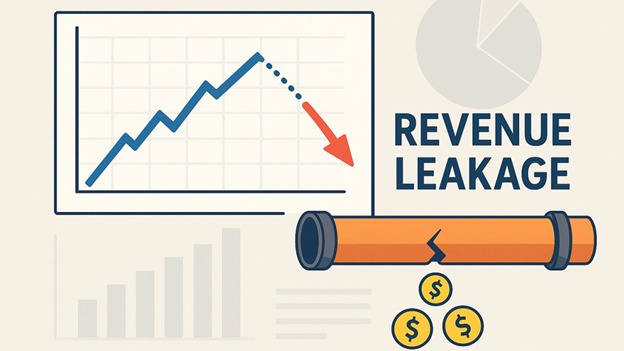
Why Billable Hours Alone Don’t Guarantee Profitability
Many IT services companies still measure delivery health primarily through billable utilization. However, high billable hours do not automatically translate into strong margins.
A project can appear operationally successful while silently becoming financially inefficient.
Without connected delivery governance, organizations struggle to identify:
- Margin drift across ongoing projects
- Revenue realization gaps
- Forecast variance
- Resource utilization inefficiencies
- Cost overruns during execution
- Delivery risks before they impact profitability
This is where execution intelligence becomes critical.
How Connected Execution Intelligence Improves Profitability
Modern IT services organizations need real-time visibility into how delivery, effort, resources, billing, and financial performance interact together.
Platforms like Whizible help organizations create a unified operational framework across:
- Project delivery
- Resource management
- Cost tracking
- Billing governance
- Utilization management
- Forecasting and reporting
Instead of waiting for month-end surprises, leadership teams gain continuous visibility into delivery and financial performance.
This enables organizations to:
- Improve project profitability
- Reduce revenue leakage
- Increase forecast accuracy
- Optimize resource utilization
- Improve billing efficiency
- Strengthen customer trust through predictable delivery
Financial Clarity Is Becoming a Competitive Advantage
For CIOs, PMOs, delivery leaders, and IT services executives, competitive advantage is no longer defined only by delivery speed.
It increasingly depends on financial clarity during execution.
Organizations that improve execution visibility are better positioned to protect margins, improve governance, and scale delivery operations with confidence.
Conclusion
Hidden revenue leakage is rarely caused by a single operational failure. It usually emerges from disconnected execution processes, delayed visibility, and poor alignment between delivery and financial governance.
IT services firms that invest in connected execution intelligence can proactively identify profitability risks before they become financial losses.
As delivery environments grow more complex, real-time operational visibility is no longer optional — it is essential for sustainable growth and margin protection.
Read more insights on delivery governance and execution intelligence at Whizible Blogs and follow Vishwas Mahajan for perspectives on modern IT services governance.