
India’s Global Capability Centers (GCCs) have rapidly evolved from cost centers into strategic innovation hubs. Enterprises across the globe are investing heavily often $60M to $120M+ annually to build high-performing GCCs focused on AI, digital transformation, engineering, and analytics.
These investments are not incremental. They are bold, strategic bets on talent, scalability and long-term enterprise value.
Yet, despite this scale of investment, a critical contradiction continues to surface.
Many GCC leaders still struggle to answer seemingly basic questions:
What percentage of high-cost talent is billable today?
What is the actual ROI of ongoing digital initiatives?
Where are delays, risks, and cost leakages originating?
This is the India GCC paradox high investment paired with low visibility.
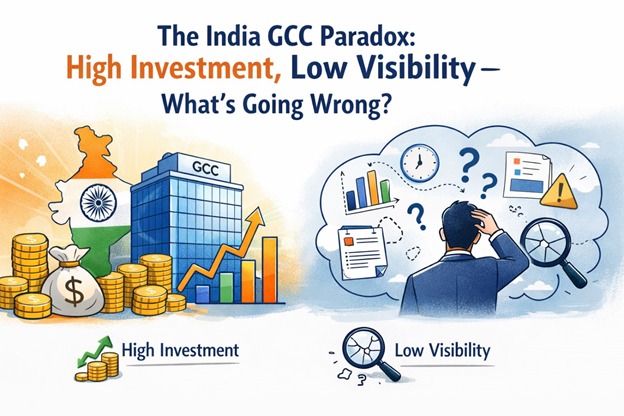
The Illusion of Control in Modern GCCs
At a surface level, GCCs appear highly structured and technologically advanced. They leverage tools like Jira for execution tracking, ServiceNow for workflows, Power BI for dashboards and Excel for financial modeling. Leadership teams review dashboards, conduct governance meetings and monitor progress regularly.
However, what exists is not true visibility, it is an illusion of control.
Because these systems operate independently, they fail to provide a unified, real-time view of execution, capacity and financial performance. What leaders see are fragmented insights rather than a connected reality.
The Problem Fragmented Systems, Fragmented Decisions
Execution data resides in one platform.
Resource allocation exists in another.
Financial metrics are tracked separately.
Strategic priorities are often managed outside operational systems.
This fragmentation leads to delayed and inconsistent decision-making. Leaders are forced to rely on lagging indicators and manually consolidated reports, which often lack accuracy and timeliness.
By the time issues are identified, corrective actions become reactive rather than proactive.
The Solution A Unified Execution and Financial Layer
The solution is not adding more reporting layers, it is eliminating fragmentation.
A unified platform that connects execution, resources and financials into a single data model enables real-time visibility. This allows leadership to shift from hindsight-driven reporting to foresight-driven decision-making.
Instead of asking “what went wrong,” organizations can continuously monitor “what is going wrong” and act immediately.
? Explore how unified visibility transforms execution:
https://www.whizible.com/
? Industry insights on governance and execution:
https://www.linkedin.com/in/vishmahajan/
The Talent Visibility Crisis High Cost, Low Utilization
Talent is the single largest investment in GCCs, especially in high-value roles such as AI/ML engineers, data scientists and domain experts, where individual costs can exceed $50,000 to $80,000 annually per resource.
Despite this, a significant portion of this talent remains underutilized at any given time.
The Problem Disconnected Skill and Demand Signals
The issue is not lack of demand, it is lack of alignment.
Skills data exists in HR systems.
Project demand is tracked in delivery tools.
Capacity planning is handled manually or through spreadsheets.
Because these systems are not interconnected, allocation decisions are delayed. High-value resources often sit idle while parallel projects struggle to find the right skills.
This results in a hidden financial drain a “Talent Tax” that can easily lead to $200,000 to $500,000+ in annual inefficiencies within a mid-to-large GCC.
The Solution Real-Time Skill-to-Demand Mapping
The key to solving this lies in real-time resource intelligence.
When skill availability, project demand, and allocation data are connected, organizations can instantly identify mismatches and reallocate resources proactively. This reduces idle time, improves utilization and maximizes the return on talent investment.
? See how resource intelligence improves utilization:
https://www.whizible.com/resource-management/
? Perspective on aligning talent with outcomes:
https://www.linkedin.com/in/vishmahajan/
The Governance Gap When Visibility Arrives Too Late
Governance frameworks in many GCCs are still built around periodic reviews weekly status reports, monthly dashboards, and quarterly business reviews. While structured, these approaches are not designed for today’s high-speed delivery environments.
The Problem Lagging Indicators and Late Escalations
Governance becomes ineffective when it relies on delayed data.
By the time a risk appears in a report, it has already impacted timelines or costs.
Manual reporting consumes valuable PMO bandwidth without improving decision quality.
Escalations occur too late, leaving minimal room for corrective action.
This results in a reactive governance model where problems are identified after they have already escalated.
The Solution Continuous, Real-Time Governance
Modern GCCs require governance that is embedded within execution itself.
Real-time tracking of risks, dependencies, progress and financial impact enables leaders to intervene early. Governance becomes proactive, continuous and data-driven rather than periodic and reactive.
? Discover how real-time governance improves delivery predictability:
https://www.whizible.com/real-time-delivery-governance-eliminate-surprises/
? Insights on modern governance practices:
https://www.linkedin.com/in/vishmahajan/
The Financial Blind Spot Revenue Without Clarity
While GCCs play a critical role in driving enterprise value, financial visibility often remains disconnected from execution realities.
The Problem No Link Between Effort, Revenue, and Margins
Time tracking, billing and revenue recognition are typically managed across separate systems.
As a result, organizations struggle to answer key financial questions:
Which projects are truly profitable?
Where are margins leaking?
How does utilization impact revenue realization?
Without a unified financial view, decision-making becomes assumption-driven rather than insight-driven.
The Solution Integrated Financial Governance
The solution lies in integrating execution data with financial metrics.
When effort tracking, billing and revenue recognition are aligned within a single system, organizations gain real-time visibility into profitability. This enables proactive margin optimization instead of retrospective analysis.
? Understand how financial governance drives profitability:
https://www.whizible.com/project-profitability/
? Learn more about outcome-driven financial strategies:
https://www.linkedin.com/in/vishmahajan/
The Strategy-Execution Disconnect
GCCs are expected to execute strategic initiatives that align with global business objectives. However, translating strategy into execution remains a persistent challenge.
The Problem Strategy Lives in Slides, Execution Lives Elsewhere
Strategic priorities are defined at the leadership level but are rarely embedded into execution workflows.
This leads to misalignment between what leadership expects and what teams deliver. Initiatives lose direction, ownership becomes unclear and accountability weakens over time.
The Solution Strategy Embedded in Execution
To bridge this gap, strategy must be integrated directly into execution systems.
When initiatives, projects and tasks are aligned with strategic goals within a unified platform, leaders gain real-time visibility into progress and outcomes. This ensures alignment, accountability and measurable impact.
? See how strategy-to-execution alignment works:
https://www.whizible.com/delivery-illusion-on-time-projects-fail-business/
? External perspective on execution alignment:
https://www.linkedin.com/in/vishmahajan/
Moving Beyond the GCC Paradox
The India GCC paradox is not a failure of investment, it is a failure of visibility.
Organizations have already invested in talent, tools and processes. However, without integration, these investments operate in silos, limiting their effectiveness.
The path forward requires a shift toward:
Unified visibility across execution, resources, and financials
Real-time decision-making instead of delayed reporting
Embedded governance instead of external oversight
Outcome-driven metrics instead of activity-based tracking
Conclusion From Visibility Gap to Strategic Advantage
India GCCs have all the ingredients to become global innovation leaders. The talent is strong, the investments are significant and the ambition is clear.
What is missing is visibility.
When organizations move from fragmented systems to a unified execution and governance model, they unlock the full value of their investments. Decisions become faster, outcomes become predictable and financial performance becomes controllable.
The paradox disappears.
And what emerges is a high-performance, insight-driven GCC that delivers measurable business impact.
? Take the first step toward unified visibility:
https://www.whizible.com/
? Gain deeper insights on execution excellence:
https://www.linkedin.com/in/vishmahajan/