
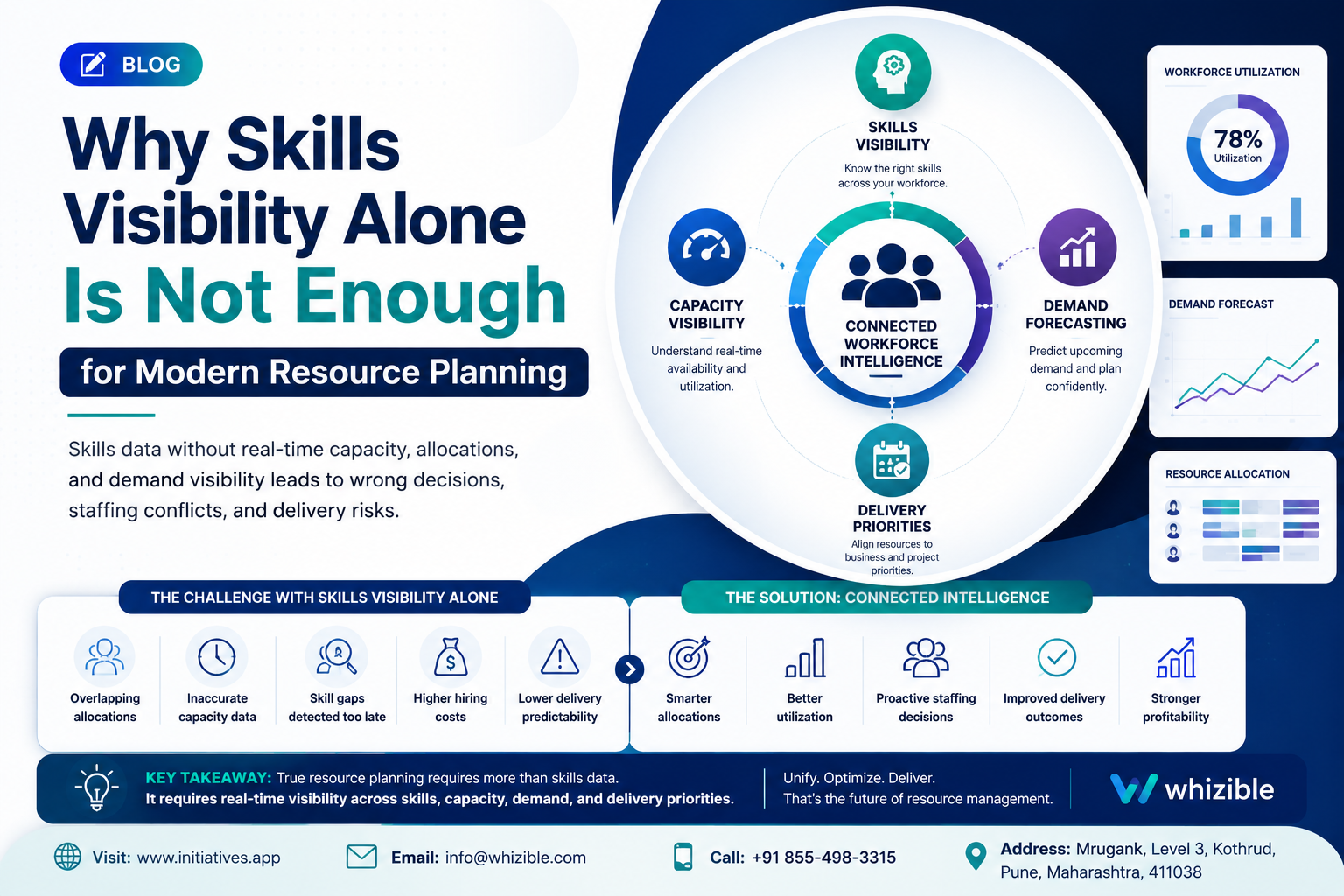
Many organizations believe that maintaining a skills inventory solves resource planning challenges.
It does not.
Knowing employee competencies without understanding live capacity, future allocations, demand forecasts, utilization trends, and delivery priorities creates incomplete workforce visibility. Skills data alone cannot help organizations determine who is actually available, when they are available, or whether future project demand will exceed operational capacity.
This is where modern resource planning begins to fail.
In fast-moving IT services environments, workforce decisions cannot rely on static spreadsheets or isolated HR systems. Project demand changes continuously. Client priorities evolve rapidly. Delivery timelines shift unexpectedly. And skills become outdated faster than traditional planning cycles can adapt.
Without unified operational visibility, organizations remain trapped in reactive execution.
A delivery leader may identify the ideal skill set for an upcoming engagement, but if that individual is already overallocated or assigned to another strategic initiative, the staffing plan immediately breaks down.
Similarly, organizations may continue external hiring despite having deployable internal talent because disconnected workforce systems cannot connect skills with live availability, utilization status, or future allocation visibility.
This creates avoidable operational inefficiencies.
The solution is not simply better reporting.
The solution is connected execution intelligence.
Modern enterprises require systems where workforce competencies, live allocations, future demand, utilization patterns, financial impact, and project priorities operate together in one unified environment. This enables leadership teams to move beyond basic skills tracking and achieve true workforce readiness visibility.
Through platforms like Whizible, enterprises can unify resource management, project execution, financial governance, workforce planning, and delivery intelligence within a single operational framework.
This allows organizations to:
- Make faster and more accurate allocation decisions
- Improve delivery predictability
- Optimize workforce utilization
- Reduce staffing conflicts
- Minimize idle bench time
- Align workforce planning directly with business outcomes
The future of resource management will not be driven by isolated visibility.
It will be driven by connected intelligence.
Organizations that unify skills, capacity, allocations, and demand forecasting will consistently outperform those still managing execution through fragmented systems and disconnected operational workflows.
For additional insights on execution governance, workforce visibility, and operational transformation, follow Vishwas Mahajan.
FAQs
Why is skills visibility insufficient for resource planning?
Skills visibility alone does not provide insight into actual workforce availability, live utilization, future demand, allocation conflicts, or delivery risk exposure.
What causes resource allocation conflicts?
Disconnected systems, outdated capacity data, delayed workforce updates, and lack of real-time operational visibility often result in duplicate or inaccurate resource allocations.
How can organizations improve workforce planning?
Organizations can improve workforce planning by integrating skills intelligence, project demand forecasting, capacity visibility, utilization management, and delivery governance into one connected platform.
Does unified resource planning support profitability improvement?
Yes. Better workforce visibility improves allocation accuracy, reduces idle bench time, prevents overutilization, enhances project margins, and improves delivery efficiency.